How Sign Shops Can Expand Their Cabinet Sign Offerings Without Adding Equipment

Sign shops can offer more cabinet signage without buying fabrication equipment by outsourcing production to a wholesale sign manufacturer. You keep control of the customer relationship, manage the job, and handle delivery and installation while your wholesale partner builds the cabinet signs to your approved specifications.

For many sign companies, outsourcing gives you a way to say yes to orders that exceed your capacity or abilities without adding equipment, floor space, or employees.

Awning Innovations is a wholesale-only sign fabrication company with more than 25 years of experience in the sign industry. We work behind the scenes as an extension of your operation, giving you access to additional manufacturing capacity without competing for your customers.

Why Cabinet Signage Can Create a Capacity Problem for Your Shop

When it comes to selling cabinets, the challenge often starts when the specifications reach production. Large sign cabinets take up valuable floor space. Your shop needs the right fabrication equipment, experienced employees, and enough room in the schedule to complete the job without delaying other orders.

Illuminated projects add electrical fabrication requirements, while larger or more specialized projects, including double-sided cabinets, can add another level of production complexity. Investing in additional capabilities may be worthwhile if cabinet signs make up a large portion of your regular production. But it is harder to justify when you only need that capacity occasionally.

The same issue affects shops that already manufacture sign cabinets. Your equipment may be perfectly capable of handling the work, but your production schedule is full. A large order or unexpected rush can push your available capacity beyond its limit.

Wholesale fabrication gives you another production option. Instead of deciding which projects you’ll be forced to reject, you can bring in a manufacturing partner when the project calls for it and say to customers with confidence.

Expanding Your Cabinet Signs Starts With the Right Wholesale Sign Company

Outsourcing fabrication does not mean giving up control of the project. You are still responsible for the result your customer receives. That makes the fabricator you choose important.

A wholesale partner should understand how relationships work in the sign industry. You are the sign company, and your team owns the customer relationship. You need a manufacturer that can take your specifications, turn them into a buildable product, and communicate with you throughout production.

Awning Innovations is wholesale-only. We serve local sign shops, large operations, national sign companies, and brokers that need specialty fabrication or additional capacity.

Our 123,000-square-foot production facility gives us the space and manpower to take on work that your current production floor may not have room to absorb. That capacity supports individual specialty orders as well as larger-volume work.

Wholesale Sign Fabrication Can Solve More Than an Equipment Gap

You do not have to be missing a piece of machinery to need a fabrication partner. Sometimes your problem is time.

Your shop may already build cabinet signs, but a large order arrives when your schedule is packed. Sending part of the workload to a wholesale manufacturer can protect the deadlines on your existing projects while allowing you to accept the new business.

Sometimes the issue is quantity. A multi-location customer may need more sign cabinets than you can comfortably fit into your normal production schedule. National sign companies can face the same problem when several locations need production at once.

Specialty projects create another use case. A customer may request a cabinet outside the sizes, styles, or configurations you typically build. Electric sign cabinets, double-sided cabinets, or other custom configurations may call for production resources you do not want to add for occasional orders.

Awning Innovations works with sign companies that need help filling those production gaps. Our role is to build the signage you need while you continue running your business and serving your customers.

Four Steps to Outsourcing Sign Cabinets in the Sign Industry

Adding outsourced cabinet fabrication to your capabilities works best when you treat it as part of your production process, not as an emergency solution after your shop gets overloaded.

1. Evaluate the Wholesale Fabricator

Ask how the fabricator moves sign cabinets from specifications into production. Look at engineering, quality control, communication, scheduling, and documentation. If electric sign cabinets are part of the work you expect to outsource, UL certification should also be part of the conversation.

Awning Innovations is UL certified and uses an engineered, blueprinted production process. We have dedicated quality staff who check work throughout production, and we document completed jobs with photographs for customer review before shipment.

Communication matters, too. Every Awning Innovations client works with an assigned sales representative, so you have a consistent point of contact for your projects.

2. Understand the Cabinet Sign Specs Before Production

A cabinet sign quote needs enough information to determine what actually has to be built. 

A wall-mounted cabinet will have different requirements than a freestanding application. Additionally, double-sided cabinets introduce their own face, illumination, structural, and mounting considerations.

Awning Innovations offers four types of sign cabinets as well as fully custom fabrication for your customers’ signage projects. You do not need to manufacture the cabinet yourself, but you do need a clear handoff between your team and ours. 

Good project information reduces questions once production begins and makes it easier to quote the work accurately. And when project specifications need to become production details, our CAD drawing and blueprinting process provides another checkpoint before the cabinet reaches fabrication.

3. Manage Your Customer’s Expectations

Your customer hired your sign company. Outsourcing cabinet signage does not change that relationship.

You remain their point of contact for the project. Keep them informed about approvals, timing, delivery, and installation the same way you would if the cabinet were moving through your own production floor. Behind the scenes, you’ll need reliable information from your fabricator to make those conversations easier.

Awning Innovations uses a structured internal scheduling system rather than relying strictly on a first-in, first-out production queue. Work is scheduled according to available capacity, helping our team provide more precise and faster production dates.

4. Build Wholesale Cabinet Fabrication Into Your Margin

Outsourcing should help you sell profitable work, not simply help you sell more work.

Price the project with the full job in mind. Fabrication is one part of your cost. Your quote may also need to account for project management, freight, site work, equipment, delivery, installation, permitting, and other costs associated with serving your customer.

A reliable wholesale price gives you a production cost you can use when building your customer quote. You can then decide whether the margin makes sense without carrying the permanent overhead of adding equipment to manufacture every cabinet in-house.

Expand Your Cabinet Signage Production Capacity Without Expanding Your Shop

When cabinet signs fall outside your equipment, available capacity, or normal production mix, a wholesale fabricator can fill the gap.

Awning Innovations has the experience and the infrastructure to provide unmatched support for your sign projects. We engineer, blueprint, fabricate, inspect, and document the signs you trust us to build.

Cabinet Signage Outsourcing FAQ

Can Sign Shops Outsource Cabinet Sign Fabrication?

Yes. Sign shops can outsource cabinet signage fabrication to a wholesale sign manufacturer while keeping the customer relationship and managing the rest of the project.

Awning Innovations works exclusively in the wholesale market. You sell and manage the job for your customer. We fabricate the sign according to the approved project specifications.

What Equipment Is Needed to Fabricate Cabinet Signs?

The exact equipment and production requirements depend on the cabinet’s size, materials, construction, illumination, and design. Fabricating electric sign cabinets also requires the capabilities to build the electrical and illumination systems specified for the project. Cabinet manufacturing requires sufficient floor space, skilled labor, and production capacity as well.

For a sign company that does not fabricate cabinets regularly, investing in additional production capabilities may not make sense. Outsourcing gives you access to a wholesale manufacturer’s existing infrastructure when you need it.

How Do Sign Shops Source Wholesale Cabinet Signs?

Start by finding a wholesale-only manufacturer with cabinet fabrication capabilities and a process that fits the way your company manages projects. Send the fabricator the available specifications so it can review the job and prepare a quote.

Before placing an order, understand how drawings, approvals, production scheduling, quality control, and communication will be handled. A strong wholesale relationship should make it easier to sell sign cabinets repeatedly, not create another layer of work for your team.
How to Handle Channel Letter Service and Replacement as a Sign Shop

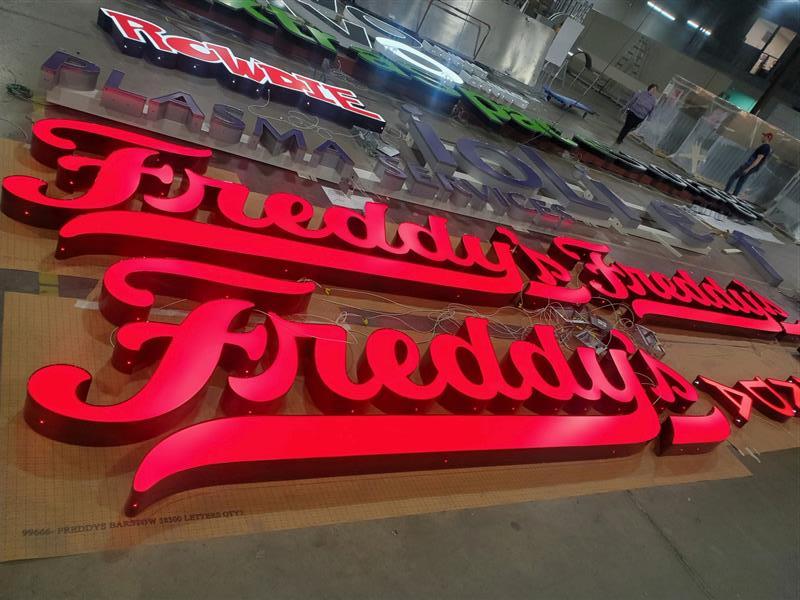
Sign shops handle channel letter service and replacement by first diagnosing the failed component, then determining whether the job requires an LED module, a face, an electrical component, or a complete letter replacement. If the original fabricator has retained production drawings, working from those records can simplify the process considerably. Exact dimensions, materials, colors, mounting details, and other specifications may already be documented.

That matters because channel letters signage rarely fails as one complete unit. One letter may have an illumination problem. A face may be cracked or damaged while the rest of the letter remains serviceable. Physical damage may make a complete replacement the better option.

For more than 25 years, Awning Innovations has fabricated signage for sign companies. Our role as a wholesale manufacturer extends beyond getting the original order out the door. Blueprinting and CAD documentation provide a production record that can help you address your customers’ service and replacement needs years later.

Channel Letter Service Starts With The Right Diagnosis

Before ordering parts or sending a replacement letter into production, determine what has actually failed. The problem may be isolated to the illumination system, face, wiring, power supply, or another component. Physical damage can also affect several parts of the letter at once.

The age and overall condition of the sign matter. Replacing a failed component makes sense when the remaining construction is sound. If the letter has extensive damage or several components are reaching the end of their useful service life, replacing the complete letter may be more practical.

A good diagnosis keeps a relatively small repair from becoming an unnecessarily large fabrication order. It also keeps your crew from arriving at the site with the wrong replacement.

A Four-Step Process For Servicing Standard Channel Letters

Sign companies can approach most service situations with a straightforward process.

1. Diagnose The Issue

Determine which letters are affected and document what you find. Check the illumination, face condition, visible physical damage, mounting, and other accessible components. Photos are useful when you need to send the findings to an outside fabricator.

The goal is to determine the appropriate level of repair. Most channel letter service needs fall into three broad categories:

  • LED module replacement: If the letter itself and its face remain in good condition, failed or inconsistent illumination may call for service to the LED system rather than fabrication of a new letter.
  • Face replacement: A cracked, faded, damaged, or otherwise unusable face may be replaceable without rebuilding the letter. Matching its dimensions, shape, color, trim, trim cap, and graphics is the priority.
  • Full letter replacement: Significant physical damage, deterioration, or a combination of component failures may make complete replacement more practical. Matching the existing sign requires much more than knowing which letter of the alphabet needs to be built.

The diagnosis determines what information you’ll need in the next step.

2. Source The Correct Replacement Components

Once you know what failed, identify the specifications of the existing sign. For LED service, that means determining what is already installed and what compatible components the repair requires. 

For a face, you may need dimensions, material, color specifications, graphics, and attachment details. A complete replacement can require the original letter profile, depth, return details, illumination configuration, mounting method, colors, and other fabrication information.

3. Work With The Original Fabricator When Possible

Many sign companies like yours work with outside fabrication partners to deliver their high-quality signs to their customers. The company that originally fabricated the channel letters may already have the information needed to reproduce the affected component accurately.

Awning Innovations creates blueprints for every project as part of its fabrication process. We take project specifications and develop production-ready CAD drawings before building to the approved design. Those records give our team and yours a reference when a customer of yours returns later with a service or replacement request.

Instead of reconstructing every specification from an installed sign, the production team can refer to documented project details. That is particularly valuable for a full letter replacement.

A replacement that is slightly off in depth, profile, color, or construction can stand out once it is installed alongside the original set. Production documentation provides a better starting point for recreating what was originally approved and fabricated.

4. Manage The Client Through The Repair

Your customer cares about getting the sign working and looking right again. They probably don’t need a lesson in channel letter fabrication.

Give them a clear explanation of what failed, what needs to be repaired or replaced, and what the work involves. If additional fabrication is required, set expectations around production and installation timing.

For a multi-location channel letter program, documentation becomes even more useful. Keep track of which location needs service, which components were replaced, and whether the issue appears isolated or may affect similar signs elsewhere in the program.

Behind the scenes, your wholesale fabrication partner can handle the manufacturing work while your company manages the customer relationship. That is the role Awning Innovations is built to fill. We manufacture for sign companies rather than selling signage directly to their end customers.

Servicing LED Channel Letters Signage

LED illumination has changed the service profile of channel letters, but LEDs still require troubleshooting when a letter goes dark, becomes inconsistent, or develops other illumination problems.

Don’t assume the LED modules themselves are always the source of the problem. The electrical system needs to be evaluated to identify the failed component before parts are ordered.

When module replacement is appropriate, compatibility matters. The objective isn’t simply to make the letter light again. The repaired letter needs to work properly alongside the rest of the sign, including its illumination appearance.

Service can become more complicated with an older set of LED illuminated channel letters if the original components are no longer available. Production records can help establish how the sign was originally configured, giving the service team and fabricator useful information when evaluating a replacement approach.

When Does A Channel Letter Face Need Replacement?

Faces take plenty of exposure over the life of an exterior sign. Impact damage or other deterioration can eventually leave a face ready for replacement even when the fabricated letter remains usable.

The first question is whether the problem is isolated to the face. If it is, replacing only that component can preserve the rest of the letter. For a replacement face, the objective is straightforward: reproduce the required component as accurately as practical without rebuilding sound parts of the sign.

When Should You Replace An Entire Channel Letter?

Full replacement makes sense when damage extends beyond a serviceable component or the existing letter is no longer a good candidate for repair.

A letter may have structural damage to its fabricated body, or multiple components may be compromised. The cost and labor involved in piecing together several repairs may also reach a point where a new letter is the cleaner solution.

A full replacement increases the importance of accurate fabrication information because the new letter has to sit beside the original letters as part of the same sign. Dimensions are only the beginning as depth, return construction, face specifications, illumination, mounting configuration, and finish can all affect the result.

For sign shops that outsource production, this is where an established relationship with a wholesale channel letters fabricator can make service considerably easier. The manufacturer isn’t seeing the project for the first time when something goes wrong. It can support the sign through more of its working life.

Your Fabricator Should Still Be Useful After The First Order

A channel letter project has a longer life than its original production schedule.

Awning Innovations has more than 25 years of wholesale sign fabrication experience, including custom channel letters. We engineer and document projects so sign companies have a manufacturing partner they can return to when the original order becomes a service request.

Keep the customer. Keep the project moving. We’ll handle the fabrication.

Request a Quote

Channel Letter Service And Replacement FAQ

How Long Do Channel Letters Last Before Needing Service?

There isn’t one service interval that applies to every channel letter sign. Materials, electrical components, installation, environmental exposure, operating hours, and physical damage can all affect when service becomes necessary.

A service call also doesn’t mean the entire sign has reached the end of its useful life. An LED component, face, or individual letter may need attention while the rest of the sign remains serviceable.

Can Individual Channel Letters Be Replaced Without Replacing The Whole Sign?

Yes. Individual channel letters can often be replaced without fabricating an entirely new set.

The replacement needs to match the relevant specifications of the existing signage, including its dimensions, construction, finish, face, illumination, and mounting configuration. Original CAD drawings and blueprints can make that process much more precise.

Awning Innovations’ project documentation gives its production team a reference when customers need replacement components or letters from previously fabricated jobs.

How Do Sign Shops Source Replacement Channel Letter Components?

Start by identifying exactly what needs to be replaced. An LED module, sign face, and complete fabricated letter require different information and different production work.

If the original fabricator is known, contact that manufacturer and ask whether it retains drawings or production records for the project. Otherwise, the sign shop may need to gather field measurements, photographs, material information, colors, mounting details, and other specifications so a fabricator can evaluate the replacement.

Working with a wholesale manufacturer that maintains detailed project records can make future sourcing easier.

Channel Letter Signage for Multi-Location Brands: How Sign Companies Manage Consistency at Scale

Sign companies maintain consistency across multi-location channel letters signage programs by setting clear production standards before fabrication begins and using the same approved specifications at every location. 

The challenge is scale. Your customers expect their brand to look consistent at every storefront, but producing the same branded appearance for 10, 50, or 100 locations across different markets takes tighter control over production and scheduling.

As a result, these large projects often require more work than your team or infrastructure may be able to handle.

At Awning Innovations, we build custom channel letters for sign companies nationwide. Our team has more than 25 years of fabrication experience and has the production capacity to support large orders and multi-location programs. Here’s everything you need to know about multi-location rollouts and how we can help.

Why Consistency Gets Harder as Channel Letter Programs Grow

A multi-location project rarely means making the exact same sign over and over. Brand standards may stay the same, but buildings do not. 

One location may have plenty of mounting space while another has architectural restrictions. Raceway requirements can vary. Letter size may need to change to fit the available elevation. Local codes and site conditions can affect how the finished sign is built and installed.

Your job is to manage those differences without losing the brand. A detailed production standard gives everyone involved in the rollout a common reference. Your sales team knows what was approved. Your installers know what to expect. We know what we need to build.

Four Details That Keep Channel Letters Consistent Across Locations

Small variations become much easier to spot when the same brand appears on storefronts across the country. A successful rollout needs controls for the details your customers notice first, such as:

1. Font Replication

Letter shape, spacing, stroke width, depth, and overall proportions need to follow the approved brand design. Production-ready CAD drawings give our fabrication team exact geometry to follow and provide a repeatable reference for later locations.

2. Color Matching

Brand colors need defined specifications. Material choices, face colors, vinyl, paint, and other finishes can affect the final appearance. Documenting approved colors and materials helps keep one production run aligned with the next.

3. Illumination Uniformity

Illuminated channel letters need a consistent nighttime appearance as well as a consistent daytime appearance. LED layout, letter depth, face materials, and other construction details influence how a sign lights. A rollout should establish the illumination specifications rather than making those decisions separately for every location.

4. Shipping to Multiple Sites

Production is only part of a national program. Completed signs may need to reach different installers or job sites according to separate construction schedules. Clear labeling, packaging, location tracking, and shipping coordination help keep the correct sign moving toward the correct site.

For your customer, all of that work should produce a simple result: the brand looks like the brand everywhere it appears.

CAD Drawings Turn Brand Standards Into Repeatable Signs

A brand guide can tell you how a logo should look. It does not necessarily tell a fabrication team how to build it. That is where production drawings matter.

Awning Innovations uses engineered CAD drawings and blueprints as part of our production process. We take the specifications for the project, translate them into production-ready drawings, review the details, and fabricate according to the approved design.

For multi-location channel letters, those drawings create a record of what was actually built.

When the next location comes through, our team does not have to start from memory or reverse-engineer an old photograph. We have documented production information to reference. If a site requires a different size or mounting configuration, we can work from the established design while accounting for that location’s requirements.

The same documentation can prove useful years later. If your customer needs a replacement component or another location after the original rollout has ended, the original project details can provide a starting point.

Custom Channel Letter Signs Need Standards and Site-Specific Engineering

For multi-location brands, consistency often means preserving the same visual identity while adjusting the sign to fit different buildings. A 10-foot-wide letter set and a 14-foot-wide set can still look like the same brand when proportions, colors, materials, illumination, and construction standards are carefully controlled.

That is especially important with custom channel letter signs. Awning Innovations offers five channel letter styles, along with options for letter depth, illumination, and mounting structure.

A Channel Letter Rollout Needs a Production Plan, Not Just a Purchase Order

High-volume signage puts pressure on a shop quickly. You still have your regular workload while a multi-location customer needs another batch of locations moving toward opening dates. Adding a large channel letter program to an already busy production floor can force you to choose between the rollout and the work you already have.

That is one reason sign companies use wholesale manufacturing partners. Awning Innovations operates from a 123,000-square-foot facility with the space and manpower to take on additional production. 

Our internal scheduling system also differs from a simple first-in, first-out production line. Jobs are scheduled according to workload and available capacity, helping our team assign production more deliberately and provide accurate completion dates. That structure matters when your rollout has multiple deadlines instead of one final due date.

Outsourcing a Rollout Lets You Add Capacity Without Adding Overhead

Winning a multi-location account is good business. Building an entirely new production operation to fulfill one account may not be.

Equipment, floor space, experienced employees, and production time all carry costs. Even a sign company that already manufactures channel letters can hit a capacity ceiling when a major rollout lands on top of its normal workload.

Wholesale fabrication gives you another option. You keep the customer relationship. Your team handles the sale, project management, delivery, and installation according to your business model. We take on the fabrication work you need us to handle.

Awning Innovations works with local sign shops, large sign companies, national providers, and brokers that need specialty production or additional capacity. Our role is to work behind the scenes as an extension of your operation.

How to Choose Channel Letter Sign Manufacturers for a Multi-Site Program

A multi-location program asks more of your sign company than a one-off project, and it also asks more of any wholesale partner you might need to bring into the fold.

Before outsourcing a rollout, look at the manufacturer’s ability to repeat approved specifications, document production details, manage volume, and communicate with your team throughout the program.

A manufacturer may produce excellent signs but struggle when dozens of locations enter the schedule at once. That problem eventually becomes your problem because you are the company answering to the customer.

At Awning Innovations, we are UL certified, and our production is engineered and blueprinted. Those processes give your team defined checkpoints between the specifications you submit and the signs your installers receive.

The relationship matters, too. Every Awning Innovations customer has an assigned sales representative, giving your company a consistent point of contact instead of starting over with someone new each time you have a question.

Nationwide Shipping Keeps Multiple Locations Moving

Signs need to reach installers across different markets, often on different schedules. Your company may be coordinating crews, permits, construction teams, landlords, and opening dates at the same time.

Awning Innovations serves sign companies nationwide, so our role can include getting fabricated signage where your program needs it to go. For larger programs, location-level organization becomes especially important as each sign needs to remain tied to the right site information throughout production, packaging, and shipment.

Your installers should receive the signs intended for their locations, built according to the approved specifications and ready for the next stage of the job.

Give Your Next Channel Letter Rollout Room to Grow

A multi-location win should not turn into a production problem. You need enough capacity to keep the rollout moving, but you also need every location to meet the standards you sold to your customer. 

Awning Innovations has spent more than 25 years building signs for sign companies. We have the space, the experience, and the skill to help you continue delivering high-quality signs to customers, no matter the scope of the project.

Request a Quote

Channel Letter Signage for Multi-Location Brands FAQ

How Are Channel Letters Standardized Across Franchise Locations?

Channel letters can be standardized by establishing approved production specifications for the brand and documenting them in CAD drawings and blueprints. Those specifications may cover letter shapes, proportions, colors, materials, depth, illumination, and mounting details.

Each site can then be engineered around its building conditions while using the approved brand and fabrication standards as the baseline.

Can Channel Letters Be Replicated Exactly Across Multiple Sites?

Channel letters can be fabricated to the same approved production specifications across multiple sites when the locations allow it. CAD drawings and documented materials provide the manufacturer with a repeatable production reference.

Exact duplication is not always appropriate because buildings, mounting conditions, sign codes, and available space can differ. In those cases, the goal is to make the required site-specific changes without changing the customer’s established visual identity.

What Is a Channel Letter Rollout Program?

A channel letter rollout program is the coordinated production and installation of branded channel letter signage across multiple business locations. Rollouts may involve a handful of sites or a large group of locations opening or rebranding over a set period.

The program typically establishes common design and production standards while tracking the specifications, schedules, fabrication, shipping, and installation requirements for individual sites.

Backlit Channel Letters: When to Recommend Them and How to Source Them

For decades, channel letter signs have maintained their status as one of the most-requested signage solutions for commercial clients. As trends evolve and businesses look for more modern solutions, channel letters have evolved, too.

For businesses looking to bring a bright yet sophisticated brand design into their space, backlit channel letters are an ideal option to make a strong visual impact. To understand when backlit channel letters are a good fit for your customers and how outsourcing can help you deliver the highest quality sign installation, keep reading this blog.

Backlit, Reverse-Lit, and Halo-Lit Channel Letters: What’s Best for Commercial Signage?

Many sign industry professionals use backlit, reverse-lit, and halo-lit as interchangeable terms when referring to signage with internal illumination. However, there are important distinctions between each type of channel letter, and each has its own advantages depending on your client’s overall brand goals.

Reverse-Lit

Reverse-lit channel letters are typically made using all aluminum or stainless steel materials with LED lighting modules mounted inside each illuminated letter. The lighting is pushed back toward the wall to create a soft, refined halo around the signage.

The interior of each sign is coated in white gloss to create a stronger LED effect and a consistent illumination at night. Its metal construction can provide a smooth, minimalist design, but doesn’t offer as much opportunity for brand customization.

Halo-Lit

Unlike reverse-lit channel letters, halo-lit letters combine both front-lit and reverse-lit illumination to create a stronger glow.

ACM or clear polycarbonate backing is a common inclusion to protect the letters and create brighter light around trimless channel letters for a sleek modern appearance. Because the brightness is stronger, the halo effect is often the first feature customers notice about the signage.

Backlit

Backlit channel letters offer the most customization and variation in their illumination. They are suitable for both indoor and outdoor use due to their sturdy aluminum and stainless steel frames and corrosion-resistant materials. Letter depth can be customized to enhance the design and desired lighting level.

When You Should Recommend Backlit Letters

To evaluate which businesses will benefit most from backlit channel letters, you should consider several key factors about the physical space and your customer’s brand identity.

Building Materials & Installation Space

Because backlit channel letters reflect illumination off the wall behind them, they are best used on buildings with a premium material on their facade to highlight the architecture and professional presence. The effect of the backlit letters is subtle and refined, and they work most effectively when the building environment matches that appearance.

We frequently recommend backlit channel letters for businesses like:

  • Corporate offices
  • Professional services
  • Luxury retail stores
  • Hotels and hospitality venues
  • Medical campuses

These types of businesses are often set in buildings with more modern architecture and sophisticated finishes, and backlit channel letters can help amplify their overall premium look.

Brand Personality

A company’s brand personality is one of the primary factors to consider when evaluating its signage solutions. The glowing effect of backlit channel letters adds an understated, upscale look to signage installations, making them well-suited for brands positioning themselves as professional or luxury businesses.

Companies that may be the best fit for backlit letters often have a brand identity that focuses on:

  • Prestige
  • Subtle confidence
  • Professional appearance
  • Innovation
  • Specialized service

Backlit channel letters are not overly bold or eye-catching like many front-lit signage installations. Instead, they build on core brand values to offer added sophistication and premium detail.

Local Sign Codes

Many cities and commercial developments have strict regulation requirements regarding signage. For some commercial areas, including business districts and mixed-use developments, local sign codes discourage the use of bright front-lit signage due to increased light spill and glare.

In these environments, backlit channel letters are a common choice to satisfy sign codes and requirements. Their indirect illumination casts a softer glare that may be more likely to meet the area’s regulations. They can also be designed to complement the surrounding architecture of the district and help present a more upscale and uniform streetscape.

Customer Budget

Backlit channel letters are considered a long-term investment in the client’s brand identity. Because they can include premium finishes, added electrical work, complex fabrication, and specialized mounting materials, backlit letters can sometimes carry a higher cost upfront.

However, businesses with the budget to support backlit channel letters often report long-lasting value from their signage. Backlit letters provide strong nighttime brand visibility, which is important for businesses open during evening hours, and create a premium brand perception that supports high-end prices.

For your sign company customers who consider their storefront appearance to play a major role in their brand identity and customer experience, backlit channel letters are a valuable investment.

When to Outsource a Backlit Channel Letter Sign from a Quality Sign Fabricator

When customers depend on you for quality signage that fits their unique specs, you need a source that’s reliable and produces consistent, quality products. To find a source you can turn to for your backlit channel letter projects, look for a wholesale fabricator with experience producing several types of illuminated signage at scale.

They should offer precision fabrication with premium materials, reliable timelines for production, and compliance with both electrical and UL requirements. If backlit channel letters are an ideal choice for your next client, consult with a nationwide wholesale sign fabricator like Awning Solutions for a fully customized and streamlined process.

Why Sign Companies Work With Awning Innovations

For more than 25 years, we’ve been the go-to wholesale fabrication partner for sign companies across the country.

With our team working as an extension of your own, you get full-scale production facilities and fabrication support while keeping your name on the final project and control over the creative process. We begin each request with thorough reviews and blueprints to prevent future issues, and we work on efficient timelines to keep projects moving. Our team is also able to perform electrical sign work, specifically required for backlit channel letters.

When production is finished, you have a backlit channel letter sign that reflects the quality of your business, and your client gets a product that fits their specs and brand identity.

Ready to Serve Your Clients to Your Fullest Potential?

If you’re selling backlit channel letter projects to your customers and searching for an outsourced fabricator you can trust, talk to our team of experts to learn more about our custom solutions.

Contact Us

What Sign Shops Should Know About LED Channel Letters Before Their Next Order

Channel letters have been prominently displayed on company storefronts since the 1920s, and today, they’re one of the most requested signage solutions. Businesses are always looking for ways to improve visibility and elevate their brand presence, and illuminated signage is a simple way to do just that.

However, finding the exact products to make a lasting impression on potential customers requires intention that starts from the moment the sign is ordered. To make the most of LED channel lighting, sign companies should take a closer look at all their options before hitting “submit” on their next customer’s order.

In this blog, the experts at Awning Innovations, an industry-leading wholesale sign fabricator, walk through everything you need to know before your next LED channel letters sign project.

What Are LED Channel Letters?

LED channel letters are three-dimensional, individually made letters used for signage on building exteriors. At night, they light up, making storefronts visible from a distance and helping them stand out from surrounding businesses. For most uses, LED channel letter signs are constructed primarily from aluminum, but also feature an acrylic face that allows the internal lighting to shine through.

What to Look for in an LED Module for Outdoor Use

The LED module within the channel letter makes all the difference regarding long-term performance and quality.

Outdoor signs are constantly exposed to rain, temperature changes, and UV rays, so sign shops need LED components built to handle potentially harsh conditions. Look for products with an IP65 rating for outdoor use for the best results.

SMD LED modules are some of the most common for outdoor advertising displays and channel letters typically installed on storefronts. These surface-mounted LEDs are visible at a wide angle and spread light evenly. For businesses hoping for that halo effect, COB modules are a top choice.

The Different Types of LED Channel Letters

Businesses no longer have to settle for run-of-the-mill, basic lettering that fades into the background. Here are some of the most popular channel letter types made with energy-efficient LEDs:

Front-Lit Channel Letters

Front-lit channel letters are among the most common you’ll see on retail storefronts, and that’s for many good reasons. These letters feature bold illumination that keeps businesses visible not only at night, but during the day as well.

Reverse-Lit Channel Letters

Reverse-lit channel letters appear similar to front-lit ones, but they have a distinct, soft halo glow. LED lights are positioned to push light toward the wall, and the result is a unique yet refined look and evenly distributed lighting.

Halo-Lit Channel Letters

For a modern look, businesses opt for halo-lit channel letters. These letters bring a dual-lit effect to a storefront, with both forward-facing LEDs and halo illumination. Like reverse-lit channel letters, this style delivers a soft halo effect that stands out for both interior and exterior uses.

Front- and Backlit Channel Letters

For businesses that love the look of front-lit channel letters but want to take it a bit further, this option makes the most sense. Front and backlit channel letters feature both a forward-facing glow and rear illumination. The result is a diffused effect that looks sophisticated in a variety of different colors.

LED vs. Neon Channel Letters

Many sign shops get hung up deciding between LED channel letters and their neon counterparts when recommending a new sign solution to their customers. While neon signage used to be common for retail stores and restaurants, today’s modern aesthetic tends to prefer LED channel letters.

Let’s take a look at how these options differ.

Specifications for Neon and LED Lighting

Both neon and LED channel letters provide illuminated signage solutions, but the technology behind them is very different. Traditional neon signs use glass tubes filled with gas that glow when electrified, while LED channel letters rely on energy-efficient light modules housed inside fabricated metal letters.

Neon lighting:

  • Requires high-voltage transformers
  • Produces a continuous glow.
  • Uses glass tubing that can be fragile

LED lighting:

  • Uses low-voltage LED modules
  • Offers consistent brightness and illumination
  • Is compatible with various designs and allows for more customization

How Long a Channel Letter Power Supply Lasts

Lifespan is one of the biggest factors sign shops consider when comparing neon and LED signage. Outdoor signs are constantly exposed to weather conditions, temperature fluctuations, and daily operating demands, making durability essential.

While neon signs can sometimes last up to 15 years, their fragility is a major issue. LED channel letters can last 50,000 hours or more and stand up against weather exposure.

How Much Energy Do Different Types of Channel Letters Use?

Neon lights require much more energy compared to LED options. Since LED channel letters operate on low-voltage systems, they use significantly less power and could ultimately contribute to lower monthly electrical bills.

Electrical Maintenance for Long-Term Outdoor Performance

Maintenance can affect the total cost of ownership, and LED channel lights generally need less of it. Neon glass tubes break often, and frequent service can raise overall costs. Aluminum and stainless steel letters with LED lighting, on the other hand, feature more durable components and little need for more than routine maintenance.

Why Outsourcing Is Key For Illuminated Signs Projects

It’s a tall order to fabricate every type of sign, every specialty order, and every rush project entirely in-house. That’s why wholesale manufacturing has become a standard within the sign industry.

Outsourcing expands capabilities without investing in additional equipment, floor space, or labor. A trusted fabrication partner allows your team to take on more complex LED channel letter projects, accept overflow work, and keep customer timelines on track without stretching internal resources too thin.

You still maintain the relationship between your team and your customer, while behind the scenes, your manufacturing partner handles fabrication up to your standards.

When It Makes Sense to Outsource LED Channel Letters

Outsourcing isn’t reserved for emergencies. Many sign companies use wholesale manufacturing whenever it makes good business sense. Common situations include:

  • Overflow production: Your shop has reached capacity, but you don’t want to delay projects or turn down new work.
  • Specialty fabrication: A customer requests reverse-lit, halo-lit, or other custom LED channel letters that require capabilities your team doesn’t regularly use.
  • Large or multi-location orders: A single project exceeds your available labor or production schedule.
  • Aggressive timelines: Your customer needs signage installed on a tight deadline, and outsourcing helps keep the project on schedule.
  • Growing without expanding: You want to increase the number of projects you can accept without investing in more equipment, production space, or additional staff.

The best outsourcing relationships aren’t built around last-minute problems. They’re built around giving your business the flexibility to accept more work, protect delivery schedules, and continue providing customers with high-quality signage, regardless of what’s already on your production floor.

Awning Innovations: Your Sign Fabrication Partner

When you’re trusting another company to fabricate your channel letters, consistency matters just as much as craftsmanship.

For more than 25 years, Awning Innovations has partnered with sign companies nationwide to produce custom channel letters, specialty signage, and overflow projects. Every order is engineered to your specifications, reviewed before production, and built by a team focused exclusively on wholesale sign manufacturing.

Our 123,000-square-foot production facility gives sign companies the capacity to keep projects moving without sacrificing quality or delivery schedules. Add dedicated project support, detailed blueprints, and rigorous quality control, and you have a manufacturing partner that works as an extension of your business rather than just another vendor.

Place Your Next LED Order With Awning Innovations

Your next LED channel letter project deserves a manufacturing partner that’s ready to deliver. Request a quote from Awning Innovations, and we’ll help you keep your project on schedule with custom wholesale fabrication built to your specifications.

FAQs About LED Channel Letters

How Long Do LED Channel Letters Last?

The lifespan of a typical LED channel letter varies greatly depending on whether it runs constantly and how much maintenance it gets. Generally, LED letters last anywhere from five to ten years and provide 50,000-100,000 hours of illumination.

Are LED Channel Letters UL-Listed?

Yes, LED channel letters should be listed, as this shows they meet the proper safety standards. Awning Innovations provides UL-certified fabrication so sign shops can be sure they’re getting a product that meets expectations.

What Is the Difference Between LED and Neon Channel Letters?

The difference lies with the type of bulbs. Neon signs are fabricated with glass tubes filled with neon gas, and although they offer a classic look, they’re also easy to break. LED lighting, on the flip side, is more energy efficient and uses modular lighting to fit a wide range of styles.